Showing posts with label variegated plants. Show all posts

1/2/11

The Care And Feeding Of Tillandsias (revisited)

A lot of people i'm close to do not even know that my VERY favorite things in the world of flora and fauna are Tillandsias, probably because most of the people i know are not "plant" people! For those of you who have no idea what they are either, here's a fairly concise description, courtesy of Wikipedia:


The plant genus Tillandsia, a member of the Bromeliad family (Bromeliaceae), is found in the deserts, forests and mountains of Central and South America, and Mexico and the southern United States in North America.The thinner-leafed varieties grow in rainy areas and the thick-leafed varieties in areas more subject to drought. Moisture and nutrients are gathered from the air (dust, decaying leaves and insect matter) through structures on the leaves called trichomes.
Tillandsia species are epiphytes (also called aerophytes or air plants) – ie they normally grow without soil while attached to other plants). Epiphytes are not parasitic, depending on the host only for support.


 (Almost everyone is familiar with one type - Spanish Moss is actually a Tillandsia species! -nanci)
The genus Tillandsia was named by Carolus Linnaeus after the Swedish physician and botanist Dr. Elias Tillandz (originally Tillander) (1640-1693).

So there you have it. Now, living in Northwestern Ohio, Tillies (as i like to call them) will not survive our brutally cold winters outside, so if i want to keep them going during that time, i have to use a little ingenuity.( If i had the money to keep a warm tropical greenhouse going for eight months, that would be ideal, but unfortunately i need most of my money for trivial things such as food, shelter, clothing, etc)!


If you look online, you will find many sites on Tillandsia care. The problem with this is most of the info comes from nurseries currently growing and selling Tillandsias, and the care is very different. If i had a huge greenhouse in Florida, i would have no problems growing Tillies! Most information is essentially correct, but once in a while you get something like this (actually taken from a nursery's site in Pasadena, California)-

How to care for Tillandsias: Tillandsias will be happy indoors or outdoors. Keep them in indirect light and give them a mist of water two or three times a week. They must be put outdoors once a week(for 24 hours more) or a fan will be helpful to promote air circulation. A drop of mild fertilizer in mist once a month is helpful.

Well. this might work, maybe for California, but not here! First of all, most of what we see in this part of the country consists of various common Tillies hot glued to branches, shells, etc., with instructions to mist them once or twice a week. With misting, they will live for maybe 2-3 months, then die (trust me!). They need deep soaking at least once a month (submerged overnight)- the misting is NOT enough. Also, in a heated house in cold weather, it's almost impossible to supply Tillies with enough humidity. It is true that they then need air circulation, because if moisture lays too long in the base of the leaves, it will rot. In warm weather they are outdoors, so it's not a problem, but what about winter? They certainly can't go outside overnight when it's 10 degrees (F). So this was my solution:
A Tillyhouse

Oh, and did i mention that another of my very favorite things is PVC pipe? It's lightweight, inexpensive, easy to cut and fit together, waterproof, and strong. This hanging greenhouse was very easy to make, the hard part was finding the corner pieces, since, handy as they are for building boxes, they aren't utilized very much in plumbing applications!

The bottom and sides are plastic (or vinyl) sheeting, and the front has Velcro attaching it to the PVC so it can be rolled down to water. There is a plastic grid in the top (actually a nursery tray for carrying cell packs of plants) so i can hang the Tillies up in the greenhouse.

 This is hanging in my unheated Florida room (Ha! WISH it was Florida!) in front of our only South facing window. The two major things i have discovered about Tillandsias in a Northern home in wintertime are: 1) They do not need warmth that much, they just need to be kept above freezing and 2) They have to have humidity and as much light as possible. i do have a heater in that room, in case there is danger of going below freezing, but i only fire it up in the evenings and in the mornings to keep the temps up. When they are enclosed in that plastic greenhouse, though, it keeps them several degrees warmer. Once every week or two on a sunny day, i open the front of the greenhouse and mist them with warm water until they are saturated.

Gettin' steamy...

I also pour some water in the bottom, as well, for extra humidity. One more thing: while i'm misting them, i exhale on them (don't laugh!). Plants like carbon dioxide (and give off oxygen), so i give them some! Does it help? i haven't a clue- but it can't hurt!

So all of my Tillandsias make it through the winter, right?
Example of fine leaves
Well, not always ....In my experience, the Tillies with the very fine leaves just don't seem to make it, and once in a while one dries out when i'm not looking (actually, through so many months, i don't always water them as faithfully as i should, either). My bad.

But many do make it, and if i lose a few, well, that's not all bad, since then i have an excuse to re-stock!
.

10/30/10

Early Fall Holdouts (2010)

i say this every year - it's a certainty that i get teary eyed at least twice a calendar year - on the day i take my tropical and house plants outside for the season, because i'm so happy it's finally warm, AND - on the day i have to take them in because of the cold! That day is not a happy one...and this is that day (sniff...)

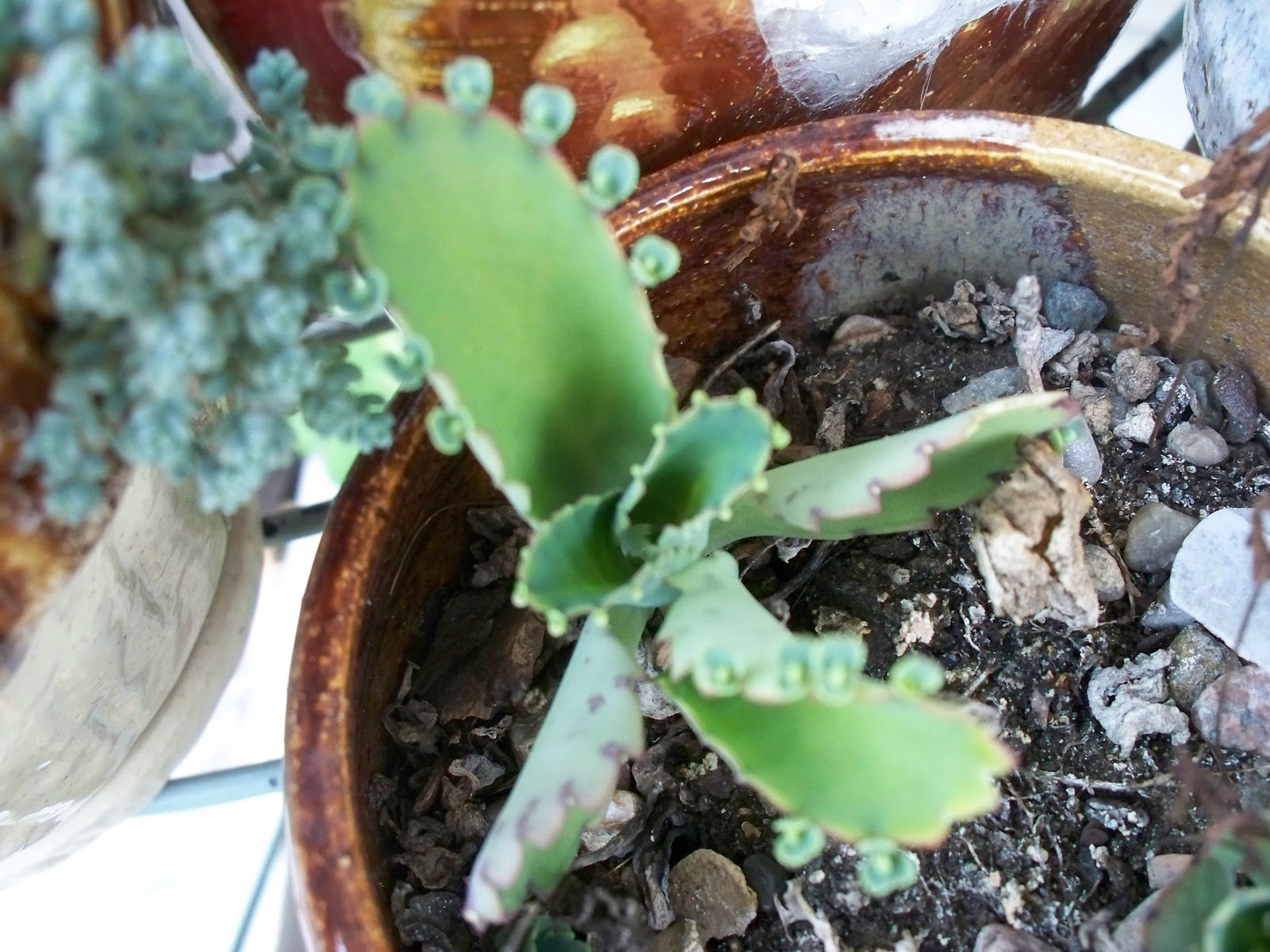
One of my Kalanchoes (Mother of Thousands) that went crazy this year. Didn't realize it was a vine - till this! Strange and ugly - but interesting!


Another Kalanchoe - i remember the cultivar name of this one - "Big Mama"! Having many babies this time of year (anyone wants any, let me know!)


The Amsonias have turned their golden autumn colors ( "amsoniared" has been my online name for many years - and yes, i know their flowers are blue...!)


Another Amsonia.... 

 And my first one (and namesake), Amsonia tabernaemontana, (Eastern Bluestar) with thicker leaves.


The Castor bean is smaller than it usually is, but still became a pretty good speciman!
But any day now, a frost will get it, and i'll have to start from seed all over again in the Spring

And one of my favorite small trees, Cherokee Daybreak dogwood, with its variegated leaves flushing pink now. Very pretty, but i'd still rather have it showing its Summer color!

4/20/10

*Collectable Plants* ~ Heuchera

When i like a genus of plants, i usually want every cultivar there is of that particular plant. One of my favorites is the Heuchera (Coral Bell) family. When i started gardening (way back in the ancient times), there were just Coral Bells - a reliable small perennial with nicely shaped green leaves that bloomed in summer with tiny, delicate lily of the valley shaped pink (or coral) flowers up and down long stems.


 Then came "Palace Purple", with large dark purple leaves that glowed when the sun shone thru them! One drawback - the flowers were a sickly greenish cream color instead of the coral!

                                            Palace Purple

That happens often in the plant breeding world - new foliage shape / color results in loss of flower interest or new flower color or disease resistance results in loss of fragrance, as in our modern roses.


But we gardeners fell for the pretty new leaves (and the blossoms themselves never really were that interesting to me), and wanted more!

The breeders got going, and these days, i swear they come out with at least a dozen new leaf colors every year!
i just walked around my yard last night, and this is a list of the Heucheras (HEW-KER-AHS) I currently own:

Cappuchino
Peach Melba

Creme Brulee

Amber Waves

Midnight Rose

Mocha Mint

Velvet Night

Autumn Bride

Green Spice

Lemon Lime

Citronelle

Caramel

Cherries Jubilee

Crimson Curls

Palace Purple

Lime Rickey


And Sunspot
 (Actually she's a Heucherella - a cross between a Heuchera and Tiarella, looks very similar to a Heuchera, but the flowers are a little "foofier".)
                                                      Sunspot
...On top of that, Heucheras are long lived, well behaved, hardy, and evergreen (or whatever color they happen to be), and the flowers (pink or not) attract hummingbirds! Can't go wrong!

2/20/10

***plAnt dAy!***(a running commentary on the most interesting collector's plants I own) *JEWEL ORCHID*

i initially ended up with a Jewel Orchid (Ludisia discolor) years ago when i was in the first Master Gardener class in my area. i may have traded someone at one of the plant swaps our Extension Service (that hosted the MG classes) had a couple of times a year - however, they didn't know what it was. i, of course, wanted it anyway - i love leaves with PINK stripes or spots on them, just because it's so unusual. It was planted in heavy potting soil at the time, definitely not great for Orchids, but since i couldn't find out what it was, that's where it stayed (again, this was long before many humans regularly went online to research things - actually, before anyone knew what "online" was!). It grew okay for a while, then it languished, and finally started to decline, no matter what i tried to do for it.

My Jewel orchid in my work office, just starting to bloom

My Master Gardener class visited the greenhouse at the Toledo Zoo during that time, and i took my plant to show the people who were giving a class for us that day. Well, they knew what it was, even repotted it for me in Orchid mix, but by that time it was too late for the poor thing....

A cutting off the same plant, showing the dark purplish green leaves with those remarkable pink stripes and unique texture.
BUT, about a year ago, i found another one, and, hey, once you know what the heck the plant is, it's real easy to grow! What a concept! There is one drawback- the flowers are numerous, but white, scentless and tiny - definitely not what one would picture an "Orchid" blossom would be. That's the way it goes sometimes in the plant world - beautiful plant; obscure flowers, or beautiful blossoms; ugly plant! Nonetheless, i'm happy with my "jewel"!

11/21/09

Plant Snobbery


Years ago, when i really started to become a plant maniac, i began to feel like less of a gardener if i planted 'common' annuals, such as Marigolds, Petunias, Geraniums (Pelargoniums), things like that. i sent for all the uncommon seed and plant catalogs, and thought, "Why would i plant the average stuff when i could be growing Salpiglossis and Clarkia, Bacopa and Euphorbia and Datura and cool things like that?!
 i would look down my nose at Impatiens


( Note to a few of my fellow gardeners - they are not "Impatients"! Impatient is what i get with people who mispronounce it!)

....and roll my eyes when everyone rushed out in May to purchase many flats of Salvia and Rose Moss. Not me- for me there was Zea Mays and Papaver Somniferum (grown by me from seed), variegated Abutilon, Persian Shield plants, and "Flirtin Skirts" hybrid Coleus from Glasshouse Works or comparable unique plant purveyors like that. So here i am, Ms. Master Gardener, Ms. Plant Collector, going along for a few years like that, some of the oddball plants did OK, and some-not so much.

*Note to novice plant maniacs- beware of Thompson & Morgan- while they DO have unusual seeds and exciting descriptions, don't get carried away by them. One warning - when they tell you a plant has "very fragrant" blossoms, keep in mind that "fragrant" means it has a smell - doesn't necessarily mean a NICE smell! Learned that the hard way. LOL   - Also, they'll stick photos in the catalogue that look like dinner plate sized blossoms, and when your little seed grown guy blooms after months of constant care under fluorescent lights, you find out that you SHOULD'VE read the rest of the description, which tells you that those huge looking flowers in the book actually could just about cover your little fingernail!*

Anyway, my  "unique" plants didn't seem to have the stamina that, well, plants like Marigolds had. I started to realize that there was a REASON that everyone planted these "boring", run of the mill annuals! They're dependable, long lasting, and long lived. Well, like today, November 21. Today i passed a flower bed with orange and yellow Marigolds that almost looked as good as they did a month ago. Didn't see any Datura still blooming...
So, these days, myself, being slightly more mature and slightly less manic than i used to be, i have Marigolds, Petunias, Pansies and all those Walmart standards AS WELL AS the collector plants. ~PLUS 'tunias are nicely fragrant! :-)

9/30/09

Never Say Die

My Sago Palm ( that i have had for about 3 years now) was doing quite well thru most of last winter, then ...it decided to die. The fronds turned yellow and dropped off (was i taking care of it correctly? Well... maybe not ...). and the base/ trunk part just sat. i figured i could just water it, and soon the new leaves would start to sprout again. Waited and waited, but no leaves. Oh-oh. At that point, many people would toss it on the compost pile, but not me. i moved it outside in the spring, once again hoping that the warm sun would generate some action. Nope. Did i pitch it? Nope. Well, the trunk wasn't soft or rotten, and also we started to get busy with the garden and art shows and summer life in general, and it was sort of forgotten about until 2 weeks ago - i glanced in its direction and guess what? Here are a bunch of new leaves sprouting! I'm so excited! What happened? i'll give you my best Master Gardener answer: i have no idea! But it's alive and well, and i'm happy...

i also   "lost" my Silver Cloud redbud last winter. The other Redbuds leafed out and bloomed, and that one was all bare trunk and branches. Did i dig it out? (Do you really think i would, after reading the above story?) i WAS awfully sure the Redbud was gone, though. Anyway, i waited some more, and then i spotted it - a tiny sprout off the trunk, very low. i wasn't too optimistic, though. i was thinking the sprout was under the graft (see definition>>>>>>>), which would mean that the growth coming out would be on the rootstock, and therefore would be a plain Redbud, which i didn't need another of. And i was partly right - about 3 sprouts started, one of which was plain green, but the other two came out variegated! This is how it looks now - a lot shorter than it was, but still among the living! So if you have a favorite plant that appears dead, stick by it and baby it for a while, you may still have a chance!

7/17/09

Beware Of Innocent - Looking Plant Tags

i acquired this 'Hakuro Nishiki' willow (Salix integra 'Hakuro Nishiki') several years ago. It was a real find at the time - beautiful pink, green and white leaves, supposed to get about 4-5 feet tall, according to the info on the plant tag, so i found an appropriate spot to plant it (for a medium/small shrub).
Well, i think you can see by the photo that it did NOT stay quite that small! That is a 6 foot fence behind it! i'm tired of DH always asking me "Why did you plant such a large plant in such a small space?" "Well, DEAR, because it was not SUPPOSED to get that big!" That happens to me a lot - it's not that i don't read the tags or that i give my plants a lot of fertilizer - they just get big!

i do have it trained as a standard; however, it sprouts constantly from the trunk. This was taken 2 months ago, and is even larger now! At the Farmers Market this Spring, a nursery was selling tons of these cultivars, trained as petite, well behaved looking ( about a foot in diameter - HA!) standards, and i took it as my own personal responsibility to follow each person who purchased one and WARN them of the monster it may become! So if you run across one of these, i would not tell you to pass it up - it IS beautiful, after all - just make sure you can give it enough room (and don't believe the tag)!

6/15/09

Impending Motherhood

i was just about to drastically cut down my variegated lilac bush, when i noticed an American Robin on her nest in the middle of said bush! This is very close to my workspace, and she would fly out, complaining loudly, every time i'd walk by. i finally started to remember she was there, and began to talk softly before i got close to her. We finally came to an understanding, and she does not worry about me so much anymore.

i can even take pics of her now, and she stays put! her mate is starting to hang around more the past few days - could that mean babies are arriving soon?

5/11/09

The "Frost Free" Date

It's almost here! May 15th- The Frost Free date! Actually, it's the AVERAGE frost free date for our area, but everyone around here (including me) treats it like it is a law that cannot be changed or wrong for any reason. If we have a frost on May 16th, we all wander around in shock, wondering HOW this could've happened! "...It can't be- the OFFICIAL FROST FREE DATE was yesterday!"

To be fair, that rarely happens- it gets CLOSE to being that cold sometimes, but generally after that date it's pretty safe. i sometimes think the date could be a couple of weeks earlier, except almost every year it happens during that time period that the weather gets warm or at least settles so you feel you can plant the tomatoes and stick the tropicals on the patio, and then weget ONE more night of freezing temps! Just enough that the pink and white leaves of the variegated Kiwi vine freeze to a crisp (and then come back a plain green when they re-emerge), and the beautiful acid yellow leaves of my "Tiger Eyes" Sumac turn brown and ugly!The 'maters can be covered, the house plants can be taken back in, but i've tried covering the Kiwi and the Sumac, and it does no good. Tonight may be that night, although i have heard varying reports, 40 degrees (F) or down to 36 degrees, so it may get dicey! And, of course, the Gunnera (who is behaving himself and throwing some fairly large leaves) can be brought in, but he's in a large container i can't negotiate by myself and don't want to have to bring in. i think i'm just gonna grit my teeth and hope for the best!

4/18/09

***plAnt dAy!***(a running commentary on the most interesting collector's plants I own) *VARIEGATED HORSERADISH*

VARIEGATED HORSERADISH
This was one of my first "must have" plants - Armoracia rusticana 'Variegata' . I love finding variegated forms of ubiquitous garden plants that you rarely find variegation on (unlike, say, a Hosta, since a great percentage of them are variegated). Variegation in leaves is caused by a loss of light absorbing pigments in the plant cells. Remove only the chlorophyll and the result is yellow variegation. Remove both chlorophyll and the yellow pigment xanthophyll and the variegation is white. The white parts of the leaves do not make food for the plant, (that's what chlorophyll does), so as a result, a lot of variegated plant aren't quite as robust as their green parents. Always an exception to the rule, though - don't think i'd ever trust a variegated MINT to behave more timidly! In my limited experience with this Horsie, it does not spread as much as the green form. Two other points: when you plant a root of Variegated Horsie, it will take a year or so to develop it's variegation - also, lots of people ask me if they can make prepared culinary horseradish with it, but i would stick with the green type for that (IMHO). It can be a knockout, though!